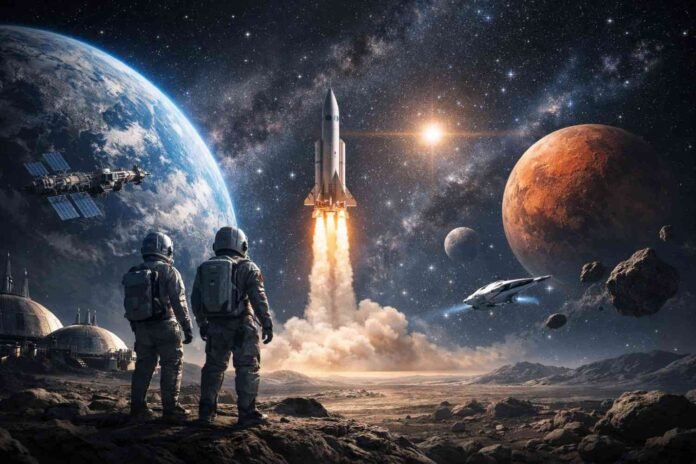
For most of human history, the night sky was something we admired from a distance. Stars were guides, gods, or mysteries—never destinations. That perspective is changing rapidly. Today, space exploration is no longer the exclusive domain of science fiction or Cold War rivalry. It has become a serious conversation about survival, progress, and what it truly means to be human.
As climate instability, resource depletion, and geopolitical tensions grow on Earth, many scientists, philosophers, and policymakers are asking the same question: Is space exploration essential to the future of humanity, or merely an expensive distraction from problems at home?
The answer is more complex—and more urgent—than it first appears.
Why Space Exploration Matters More Than Ever
At its core, space exploration is not about escaping Earth. It’s about understanding it.
Satellites already play a silent but critical role in our daily lives. They monitor climate change, predict natural disasters, enable global communication, and support navigation systems that modern economies depend on. Without space-based technology, the world would be less connected, less informed, and far more vulnerable.
But the importance of space exploration goes beyond practical benefits. It challenges humanity to think long-term—on scales of centuries rather than election cycles.
When we explore space, we are forced to confront questions that Earth-bound thinking often avoids:
- How do we protect life in a hostile environment?
- How do we cooperate across borders for a shared goal?
- What knowledge must we preserve if civilization is disrupted?
In this sense, space exploration is an investment in resilience.
Space as a Survival Strategy for Humanity
One uncomfortable truth shapes the future of humanity: Earth is finite.
Asteroid impacts, supervolcanoes, pandemics, and long-term climate shifts are not hypothetical threats—they are scientifically documented risks. While none of these guarantees extinction, history shows that even advanced civilizations can collapse when multiple pressures converge.
Establishing a sustained human presence beyond Earth could act as a form of planetary insurance.
This does not mean abandoning our responsibility to protect Earth. On the contrary, the technologies developed for surviving in space—closed-loop life support, efficient recycling systems, renewable energy optimization—are already influencing sustainable solutions on our planet.
In other words, preparing for life beyond Earth often improves life on Earth.
Mars, the Moon, and the Next Chapter of Human Expansion
The renewed global interest in the Moon and Mars signals a shift from exploration to settlement.
- The Moon offers a testing ground for long-term off-world living, resource extraction, and space manufacturing.
- Mars represents a bold step toward becoming a multi-planet species, with its own challenges in gravity, radiation, and psychology.
Yet the hardest obstacles are not technological—they are human.
Living in confined environments, managing isolation, and maintaining social cohesion will test our emotional intelligence as much as our engineering skills. Space exploration forces humanity to evolve not just scientifically, but culturally and ethically.
The Ethical Questions We Can’t Ignore
As space becomes more accessible, ethical considerations become unavoidable.
Who owns space resources?
Who decides which nations or individuals can settle other worlds?
How do we prevent the mistakes of colonization from repeating on a cosmic scale?
The future of humanity in space must be guided by cooperation rather than competition. Without thoughtful governance, space exploration risks amplifying inequality instead of uniting the species.
Encouragingly, international collaborations—such as shared space stations and joint missions—suggest that cooperation is possible when survival and discovery outweigh short-term interests.
How Space Exploration Shapes Human Identity
The most profound impact of space exploration lies in how it changes our perspective.
Images of Earth from space reveal a fragile, borderless world suspended in darkness. That viewpoint has influenced environmental movements, global cooperation, and a growing awareness that humanity shares a single fate.
As we venture further into space, the idea of “us versus them” becomes harder to justify. From orbit—or from Mars—human divisions appear trivial.
Space exploration may not make us perfect, but it pushes us toward humility, curiosity, and shared responsibility.
The Future of Humanity Is Not Just Out There—It’s Within Us
Space exploration is not a guarantee of survival. It is an opportunity.
An opportunity to rethink how we use resources
A chance to collaborate across cultures
A chance to design societies intentionally rather than reactively
The future of humanity will be shaped not only by how far we travel into space, but by the values we carry with us when we go.
If we treat space as a new frontier to exploit, we will repeat old failures on a larger scale. But if we treat it as a shared experiment in survival and cooperation, space exploration could become humanity’s most meaningful project yet.
The stars are not calling us because they are easy to reach—but because they force us to become better than we are today.