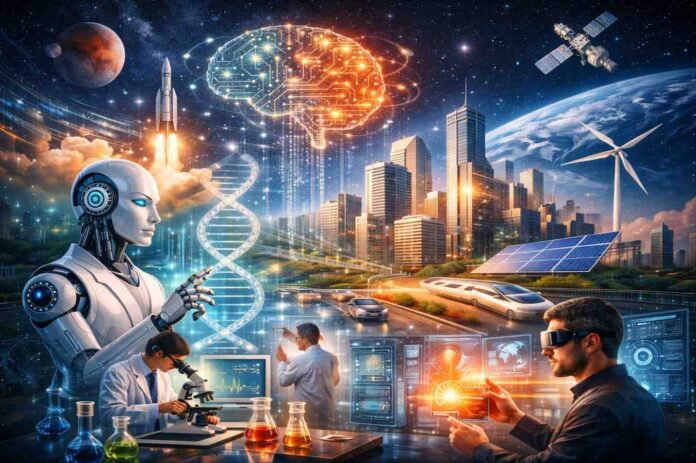
The future is no longer a distant concept we imagine through science fiction. It is being built right now—quietly, rapidly, and often invisibly—through the combined force of science and technology. From how we heal our bodies to how we communicate, work, travel, and even think, scientific discovery and technological innovation are redefining what it means to live in the modern world.
What makes this moment unique is not just the speed of progress, but the way different fields are converging. Biology meets data science. Physics meets artificial intelligence. Human creativity meets machine precision. Together, they are shaping a future that is smarter, more connected, and full of both promise and responsibility.
Science and Technology’s Changing Relationship
Science and technology are often used interchangeably, but they serve different roles. Science helps us understand the laws of nature—how things work. Technology applies that understanding to create tools, systems, and solutions.
In today’s world, the relationship is circular. Scientific breakthroughs fuel technological advances, and new technologies enable deeper scientific exploration. For example, powerful computing systems allow scientists to model climate change more accurately, while advances in materials science lead to faster and more efficient processors.
This feedback loop is accelerating innovation across nearly every sector.
Artificial Intelligence and Data: Redefining Intelligence Itself
Artificial intelligence (AI) is one of the most influential forces shaping the future. What began as simple rule-based systems has evolved into machine learning models capable of recognizing patterns, interpreting language, and making decisions.
AI is already transforming industries:
- Healthcare: Algorithms assist doctors in diagnosing diseases earlier and more accurately, especially in medical imaging and genetics.
- Finance: Fraud detection systems analyze millions of transactions in real time.
- Education: Personalized learning platforms adapt content to individual students’ needs.
What’s most transformative is not automation alone, but augmentation—AI enhancing human capabilities rather than replacing them. The future workplace will value those who can work with intelligent systems, not compete against them.
Biotechnology and Medicine: A New Era of Health
Few areas show the power of science and technology more clearly than modern medicine. Advances in biotechnology are shifting healthcare from reactive to predictive and personalized.
Key developments include:
- Gene editing: Technologies like CRISPR allow scientists to target and potentially correct genetic disorders.
- Personalized medicine: Treatments tailored to an individual’s DNA, lifestyle, and environment.
- Wearable health technology: Devices that continuously monitor heart rate, sleep, and activity, helping people prevent illness rather than just treat it.
These innovations are extending life expectancy and improving quality of life, while also raising ethical questions about access, privacy, and genetic responsibility.
Renewable Energy and Climate Science: Powering a Sustainable Future
As climate change becomes one of the defining challenges of our time, science and technology are essential to building a sustainable future.
Renewable energy technologies—such as solar, wind, and green hydrogen—are becoming more efficient and affordable. At the same time, climate science provides the data needed to understand environmental changes and predict future risks.
Emerging solutions include:
- Smart energy grids that optimize electricity use
- Carbon capture technologies that reduce emissions
- Advanced battery storage for clean energy reliability
The future of energy is not just cleaner—it’s smarter, decentralized, and data-driven.
Space Exploration: Expanding Human Possibility
Space science is no longer limited to government agencies. Private companies, advanced robotics, and miniaturized technology are opening a new era of exploration.
Satellites improve global communication, navigation, and disaster response. Mars missions push the boundaries of human engineering. Space telescopes deepen our understanding of the universe—and our place within it.
Beyond exploration, space technology often leads to practical innovations on Earth, from improved materials to better medical imaging systems.
Education and Work: Learning and Earning in a Digital World
Science and technology are reshaping how people learn and work. Traditional career paths are giving way to continuous learning models, where skills matter more than credentials.
Remote work, virtual collaboration tools, and digital learning platforms are creating opportunities that were unthinkable a generation ago. At the same time, automation is redefining job roles, making adaptability one of the most valuable human skills.
The future belongs to those who can learn, unlearn, and relearn.
Ethical Challenges and Human Responsibility
While the future shaped by science and technology is exciting, it is not without risks. It is necessary to take proactive measures to address issues, including data privacy, algorithmic unfairness, environmental effects, and unequal access to technology.
Scientific progress without ethical guidance can widen social gaps rather than close them. This makes interdisciplinary thinking—combining science, technology, philosophy, and policy—more important than ever.
The future is not shaped by innovation alone, but by the choices we make about how innovation is used.
What the Future Really Looks Like
The future shaped by science and technology will not be a single dramatic moment. It will be a series of small, meaningful changes—smarter cities, healthier lives, cleaner energy, and a deeper understanding of ourselves and the universe.
Ultimately, science provides the knowledge, technology provides the tools, and humanity provides the direction.
How the future unfolds depends not just on what we can build, but on what we choose to develop.
Final Thoughts
How science and technology are shaping the future is not just a topic—it is an ongoing story we are all part of. As innovation continues to accelerate, the most important question is no longer what’s possible, but what’s responsible.
The future is being shaped today, and science and technology are holding the pen.