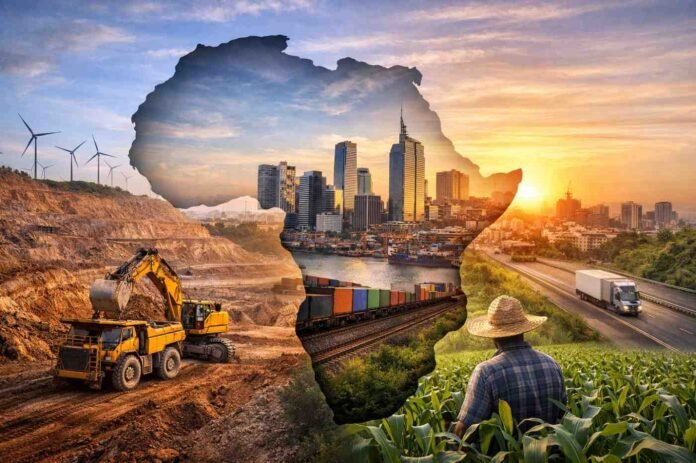
Africa’s economic story is far more complex than the outdated narratives that still dominate global conversations. Across the continent, countries are experiencing rapid transformation, driven by demographic change, digital innovation, expanding regional trade, and renewed investment interest. At the same time, Africa continues to grapple with structural challenges that constrain growth and expose economic vulnerabilities.
Understanding economic growth and challenges across Africa requires moving beyond broad generalizations and examining the forces shaping development at national, regional, and continental levels.
Africa’s Economic Growth: More Than a Single Story
Over the past two decades, several African economies have recorded sustained growth, often outpacing global averages during periods of expansion. A combination of factors has fueled this growth:
- Growing domestic consumption due to the expansion of the middle class
- Expanding urbanization and infrastructure development
- Increased access to mobile technology and digital finance
- Improved macroeconomic management in several countries
East African economies have emerged as consistent performers, supported by public investment and services-led growth. West Africa continues to benefit from agriculture, trade, and a vibrant entrepreneurial culture, while parts of Southern Africa remain industrial and resource-driven.
Importantly, Africa’s growth is no longer solely dependent on commodities. While oil, gas, and minerals still play a role, sectors such as fintech, agribusiness, renewable energy, healthcare, and creative industries are gaining traction.
The Demographic Advantage—and the Risk
The youngest population in the world is found in Africa. This demographic reality offers a powerful growth dividend if properly harnessed. A large, youthful workforce can boost productivity, innovation, and consumer demand.
However, the same demographic trend becomes a liability when economies fail to generate sufficient jobs. High youth unemployment and underemployment remain among the most pressing economic challenges across Africa. Education systems often struggle to align skills with labor market needs, leaving many young people disconnected from formal economic opportunities.
Without sustained investment in education, vocational training, and private-sector job creation, the demographic advantage could turn into social and economic strain.
Infrastructure Gaps and Their Economic Impact
Economic growth and infrastructure development are intimately related, but many African nations continue to struggle with deficiencies in digital connectivity, power, transportation, and water systems.
Unreliable electricity raises production costs for businesses. Inadequate transport networks limit regional trade and agricultural productivity. Poor digital infrastructure restricts access to global markets, particularly for small and medium-sized enterprises.
While progress has been made through public-private partnerships and regional infrastructure projects, financing gaps and implementation delays continue to slow momentum.
Debt, Inflation, and Fiscal Pressure
Macroeconomic stability remains a critical concern. Several African economies are navigating rising debt levels, currency volatility, and inflationary pressure. External shocks—such as global interest rate changes, commodity price swings, and climate-related disruptions—can quickly strain public finances.
Debt servicing costs reduce fiscal space for social spending and capital investment, making it harder for governments to support inclusive growth. Strengthening domestic revenue collection, improving public financial management, and diversifying export bases are essential to reducing vulnerability.
Climate Change as an Economic Challenge
Climate risk is no longer a future concern—it is an active economic constraint. Agriculture-dependent economies are particularly exposed to changing rainfall patterns, droughts, and flooding. These disruptions threaten food security, export earnings, and rural livelihoods.
At the same time, Africa holds significant potential in renewable energy, climate-smart agriculture, and green industrialization. With the right policies and financing, climate adaptation and mitigation can become engines of sustainable economic growth rather than barriers.
Trade Integration and the Promise of Regional Markets
One of the most promising developments shaping economic growth across Africa is the push for deeper regional integration. Expanding intra-African trade reduces reliance on external markets and encourages value-added production.
Regional supply chains, shared infrastructure, and harmonized regulations can help African businesses scale beyond national borders. However, implementation challenges—ranging from border inefficiencies to policy inconsistency—still limit the full impact of integration efforts.
Governance, Institutions, and Investor Confidence
Strong institutions are foundational to long-term economic growth. Political stability, transparent regulation, and predictable policy environments directly influence investment decisions.
While governance quality varies widely across the continent, countries that have improved regulatory frameworks and strengthened institutions tend to attract more diversified investment. Conversely, weak governance, corruption, and policy uncertainty remain significant economic challenges in parts of Africa.
The Road Ahead: Balancing Growth and Resilience
Africa’s economic future will be shaped by how effectively countries manage the intersection of growth opportunities and structural constraints. Sustainable progress depends on:
- Investing in human capital and job creation
- Building resilient infrastructure
- Strengthening fiscal and debt management
- Supporting private-sector innovation
- Addressing climate risks proactively
The narrative of economic growth and challenges across Africa is ultimately one of transition. The continent is not defined by either struggle or success alone, but by a dynamic process of change that continues to unfold.
With the right mix of policy reform, investment, and regional cooperation, Africa’s economies can move beyond volatility toward inclusive and resilient growth—on their own terms.