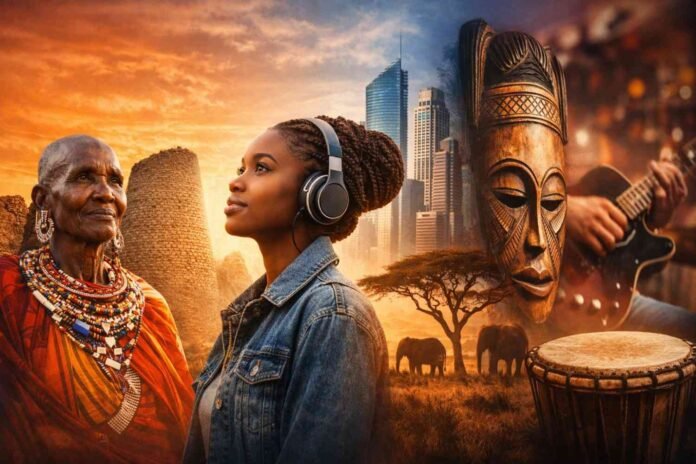
Africa’s modern identity is not a break from its past—it is a continuation of it. Across the continent, cultural heritage remains a powerful force shaping how people see themselves, express creativity, govern communities, and navigate globalization. From language and fashion to music, spirituality, and social values, Africa’s traditions are not relics of history. They are living systems, constantly evolving in dialogue with the modern world.
Understanding cultural heritage and modern identity in Africa means recognizing how ancient practices and contemporary realities coexist, conflict, and ultimately reshape one another.
What Cultural Heritage Means in the African Context
Cultural heritage in Africa goes far beyond monuments and museums. It includes:
- Indigenous languages and oral storytelling traditions
- Spiritual belief systems and rituals
- Traditional governance and kinship structures
- Art forms such as sculpture, textiles, dance, and music
- Agricultural knowledge, healing practices, and craftsmanship
Much of this heritage has been preserved not through written records but through memory, performance, and communal participation. Elders, griots, artisans, and spiritual leaders have long served as custodians of collective knowledge.
Unlike static definitions of heritage, African cultural traditions are adaptive. They respond to environmental changes, social needs, and historical disruptions—including colonialism.
Colonialism and the Reframing of African Identity
Colonial rule deeply disrupted African cultural systems. European powers imposed foreign languages, borders, education models, and value systems, often dismissing indigenous knowledge as inferior or “primitive.” This forced many Africans to negotiate between inherited traditions and imposed identities.
Yet colonialism did not erase African heritage. Instead, it reshaped how identity was expressed. Resistance movements, nationalist ideologies, and post-independence cultural revivals drew heavily from traditional symbols, languages, and philosophies.
Modern African identity emerged from this tension—rooted in heritage, but forged through struggle and adaptation.
Language as a Foundation of Modern African Identity
Language is one of the strongest links between heritage and identity. While colonial languages like English, French, and Portuguese dominate official spaces, indigenous languages remain central to everyday life, humor, music, and worldview.
Across Africa:
- Musicians blend local languages with global genres.
- Writers incorporate indigenous expressions into contemporary literature.
- Urban youth create new slang rooted in ancestral speech patterns.
Language preservation is increasingly seen as cultural resistance and self-definition. Speaking one’s mother tongue is not merely communication—it is identity affirmation.
Fashion, Art, and the Visual Language of Heritage
African fashion and visual art demonstrate how heritage thrives in modern expression. Traditional fabrics, patterns, and symbols are reimagined by contemporary designers and artists for global audiences.
Examples include:
- Ankara and kente are used in modern tailoring
- Beadwork and body symbolism influence jewelry and street fashion
- Ancient motifs appearing in digital art, murals, and branding
These creative industries do more than generate income—they tell stories of origin, resilience, and pride. For many young Africans, wearing traditional-inspired fashion is a political and cultural statement.
Music and Popular Culture: Tradition Meets Innovation
African music is one of the most visible spaces where heritage and modern identity intersect. Contemporary genres draw deeply from traditional rhythms, instruments, and storytelling styles.
Afrobeats, Amapiano, Highlife, Gnawa fusion, and Afro-jazz all reflect this blend. While the production may be modern and global, the soul of the music often remains unmistakably local.
Music becomes a bridge—connecting village ceremonies to global streaming platforms, and ancestral rhythms to modern youth culture.
Spirituality and Values in a Changing World
Despite rapid urbanization and technological growth, traditional belief systems continue to influence moral frameworks and social behavior. Concepts such as communal responsibility, respect for elders, and harmony with nature remain deeply embedded.
Even where formal religions dominate, indigenous spirituality often coexists beneath the surface—shaping rituals, naming practices, conflict resolution, and life-cycle ceremonies.
Modern African identity does not discard spirituality; it adapts it to contemporary realities.
Youth, Technology, and Cultural Reinterpretation
Africa’s youth population is redefining heritage in bold ways. Through social media, film, podcasts, and digital storytelling, young Africans are reclaiming narratives once filtered through colonial or Western lenses.
They are:
- Reviving forgotten histories
- Challenging stereotypes
- Redefining what it means to be “modern” and “African.”
Technology has not diluted cultural identity—it has amplified it. Heritage is now shared, debated, and reinvented in real time.
The Global African Identity
Migration and the African diaspora add another layer to modern identity. Africans living abroad often reconnect with their cultural heritage as a way of grounding themselves in unfamiliar environments.
This global exchange creates hybrid identities—African and international, traditional and modern. Rather than weakening heritage, this expansion strengthens its relevance and adaptability.
Challenges Facing Cultural Heritage Today
Despite its resilience, African cultural heritage faces real threats:
- Language extinction
- Commercial exploitation without community benefit
- Loss of traditional knowledge due to urban migration
- Over-simplification of culture for tourism
Preserving heritage requires more than nostalgia. It demands policy support, education reform, community involvement, and respect for indigenous knowledge systems.
Why Cultural Heritage Still Matters
Cultural heritage is not about looking backward—it is about understanding who we are and how we move forward. In Africa, heritage provides:
- A sense of belonging
- Social cohesion
- Creative inspiration
- Ethical grounding
Modern African identity is strongest when it embraces its roots while engaging the world with confidence.
Conclusion: Identity in Motion, Anchored in Heritage
Cultural heritage and modern identity in Africa are not opposing forces. They are intertwined, shaping a future that honors the past without being confined by it.
Africa’s story is not one of cultural loss, but of cultural continuity—adapted, reimagined, and carried forward by each generation. In that continuity lies the continent’s strength, creativity, and enduring sense of self.