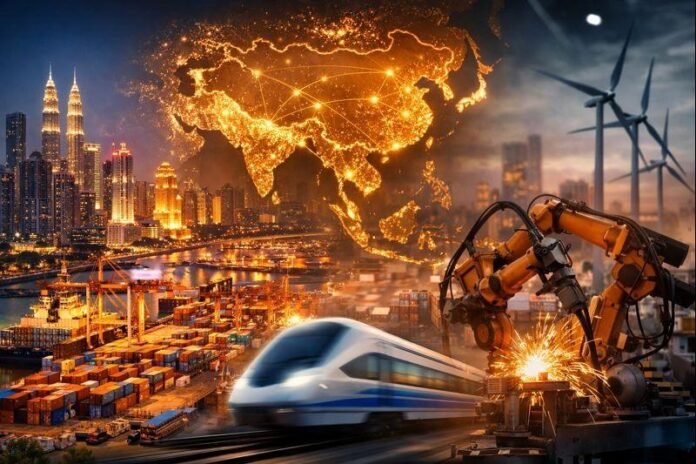
Asia is undergoing one of the most significant economic transformations of the 21st century. From shifting supply chains and rapid technological adoption to demographic changes and evolving trade relationships, the continent is redefining its role in the global economy. Asia in transition is no longer a future narrative—it is a present reality reshaping industries, labor markets, and geopolitical influence.
This article explores the key economic shifts reshaping Asia, the forces driving these changes, and what they mean for the world.
The Rise of a Multipolar Asian Economy
For decades, China dominated conversations about Asian economic growth. While China remains a major global force, Asia’s financial story is becoming increasingly multipolar.
Countries such as India, Vietnam, Indonesia, and the Philippines are emerging as critical growth engines. India’s expanding digital economy, Vietnam’s manufacturing boom, and Indonesia’s resource-driven industrialization signal a broader redistribution of economic power across the continent.
This diversification reduces regional dependency on a single market and creates new opportunities for investment, trade, and innovation.
Supply Chain Realignment and the “China Plus One” Strategy
One of the most defining economic shifts in Asia is the restructuring of global supply chains. Rising labor costs, geopolitical tensions, and pandemic-era disruptions have encouraged multinational corporations to rethink manufacturing concentration.
The result is the “China Plus One” strategy, where companies maintain operations in China while expanding production to other Asian countries, such as:
- Vietnam
- Thailand
- Malaysia
- Bangladesh
- India
This shift has accelerated infrastructure development, job creation, and foreign direct investment across Southeast and South Asia, reinforcing Asia’s role as the world’s manufacturing backbone—just more distributed than before.
Digital Transformation Accelerating Economic Growth
Asia is home to some of the world’s fastest-growing digital economies. E-commerce, fintech, mobile payments, and AI-powered services are changing how companies run and how customers interact with markets.
Key drivers of Asia’s digital economic shift include:
- High smartphone penetration
- Young, tech-savvy populations
- Government-backed digital initiatives
- Rapid fintech adoption in underbanked regions
This shift is being spearheaded by China, India, and Southeast Asia, where digital platforms are giving millions of small enterprises access to local and international markets for the first time.
Demographic Changes Reshaping Labor Markets
Demographics play a critical role in Asia’s economic transition. While countries like Japan and South Korea face aging populations and shrinking workforces, others, such as India and Vietnam, benefit from youthful demographics.
These contrasting trends are reshaping labor flows, productivity strategies, and economic policies. Aging societies are investing in automation and healthcare innovation, while younger economies focus on education, skill development, and job creation.
The long-term outcome is a more interconnected Asian labor ecosystem, where talent mobility and cross-border collaboration become increasingly important.
Green Growth and the Energy Transition
Asia’s economic transformation is also being shaped by sustainability and climate priorities. The continent is essential to the global green transition because it is the world’s biggest energy consumer and carbon emitter.
Major Asian economies are investing heavily in:
- Renewable energy (solar, wind, hydro)
- Electric vehicle production
- Green manufacturing
- Climate-resilient infrastructure
China leads in renewable capacity, while countries like India and Vietnam are rapidly scaling clean energy investments. This shift not only addresses climate challenges but also creates new industries and long-term economic resilience.
Regional Trade and Economic Integration
Trade agreements like the Regional Comprehensive Economic Partnership (RCEP) are strengthening economic cooperation throughout Asia. These frameworks are reducing tariffs, harmonizing regulations, and strengthening intra-Asian trade.
As a result, Asia is becoming more economically self-sustaining, with regional supply chains and consumer markets driving growth from within rather than relying solely on Western demand.
This transition enhances Asia’s global influence and reshapes international trade dynamics.
Challenges Facing Asia’s Economic Transition
Despite its momentum, Asia’s economic shift is not without challenges:
- Rising income inequality
- Geopolitical tensions
- Infrastructure gaps
- Climate vulnerability
- Financial market volatility
How governments address these issues will determine whether Asia’s transition leads to inclusive, sustainable growth or uneven development across regions.
What Asia’s Economic Shift Means for the World
Asia’s transformation has global implications. As the continent moves up the value chain, the world will see changes in trade flows, investment patterns, and innovation leadership.
For businesses, investors, and policymakers, understanding Asia in transition is no longer optional—it is essential for navigating the future global economy.
Conclusion
The economic shifts reshaping Asia mark a historic turning point. A more diversified, digitally driven, and interconnected continent is emerging—one that will define global growth for decades to come.
As Asia continues its transition, adaptability, innovation, and regional cooperation will be the keys to sustaining momentum and shaping a more balanced global economic order.