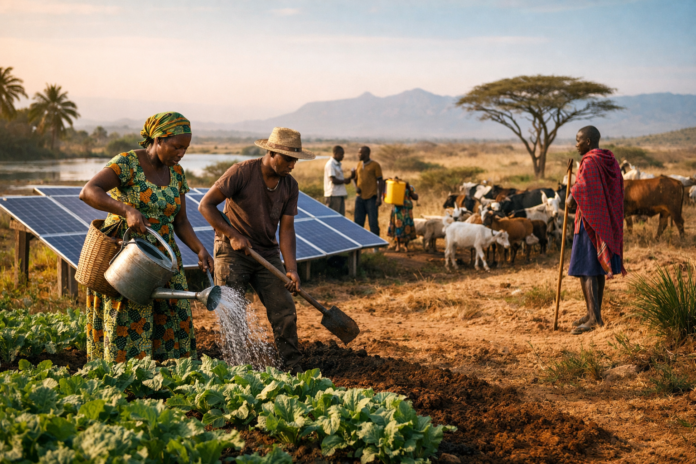
Africa’s relationship with climate change is often framed through crisis—droughts, floods, food insecurity, and displacement. But this narrow narrative misses a powerful truth. Across the continent, communities are not merely surviving climate pressure; they are adapting, innovating, and leading resilience efforts that the world can learn from.
Climate, community, and change are deeply intertwined in Africa’s story. From indigenous farming techniques to youth-led climate movements, Africa’s resilience is rooted in collective action, cultural knowledge, and forward-thinking solutions.
This is not a story of vulnerability alone—it is a story of strength.
Understanding Africa’s Climate Reality
Africa contributes less than 4% of global greenhouse gas emissions, yet it experiences some of the most severe climate impacts. Rising temperatures, unpredictable rainfall, desertification, and coastal erosion affect livelihoods that are heavily dependent on natural ecosystems.
Key climate challenges include:
- Prolonged droughts in the Horn of Africa
- Flooding in West and Central Africa
- Desert expansion in the Sahel
- Sea-level rise is affecting coastal cities and island nations.
Despite these pressures, African communities are responding with resilience rather than resignation.
Community at the Heart of Climate Resilience
Indigenous Knowledge as a Climate Solution
Long before climate change became a global conversation, African communities developed systems to live in balance with nature. Indigenous knowledge remains one of the continent’s strongest resilience tools.
Examples include:
- Zai pits in Burkina Faso that restore degraded land
- Pastoral mobility systems that protect grazing ecosystems
- Traditional water harvesting methods in arid regions
Scientists and policymakers are now recognizing these practices as effective, low-cost climate adaptation strategies.
Women Leading Local Climate Action
Across Africa, women play a central role in agriculture, water management, and household energy use—placing them on the front lines of climate change.
In many regions:
- Women lead reforestation initiatives.
- Female farmers pioneer climate-smart agriculture
- Women-led cooperatives promote sustainable livelihoods.
Empowering women is not only a social priority—it is a proven climate solution.
Youth Driving Change Across the Continent
Africa has the world’s youngest population, and its youth are shaping the future of climate action.
Young Africans are:
- Building clean energy startups
- Leading grassroots climate campaigns
- Using digital tools to track environmental change
- Advocating for climate justice on global platforms
This generation is redefining resilience—not as survival, but as transformation.
Innovation Meets Sustainability
Renewable Energy Transforming Communities
Millions of Africans still lack access to reliable electricity. Climate change, paradoxically, has accelerated innovation in renewable energy.
Solar microgrids, wind projects, and clean cooking technologies are:
- Powering rural communities
- Reducing reliance on fossil fuels
- Creating green jobs
- Improving education and healthcare access
Africa is not waiting for external solutions—it is building its own.
Climate-Smart Agriculture and Food Security
To protect food systems, farmers across Africa are adopting climate-smart techniques such as:
- Drought-resistant crops
- Agroforestry systems
- Precision irrigation
- Soil regeneration practices
These approaches increase yields while protecting ecosystems, proving that sustainability and productivity can coexist.
The Role of Policy and Global Partnerships
While community-led action is vital, supportive policies and fair global cooperation are equally important.
Africa’s resilience efforts require:
- Climate financing that reaches local communities
- Fair carbon markets
- Technology transfer without barriers
- Strong regional collaboration
Climate justice means recognizing Africa not as a victim, but as a partner and innovator in global climate solutions.
Changing the Global Narrative About Africa
Too often, Africa’s climate story is told through statistics rather than lived experiences. But resilience is not measured only in data—it is visible in communities rebuilding after floods, farmers adapting to new seasons, and young leaders demanding accountability.
Africa is not waiting to be saved.
It is actively shaping a climate-resilient future grounded in community strength and collective wisdom.
Why Africa’s Resilience Story Matters to the World
As climate impacts intensify globally, Africa’s approach offers valuable lessons:
- Local solutions can outperform centralized systems.
- Cultural knowledge enhances modern science.
- Community-led action creates lasting impact.
The future of climate resilience is not only technological—it is human.
Final Thoughts
Climate, Community, and Change: Africa’s Resilience Story is a testament to what is possible when people work with nature rather than against it. Amid uncertainty, African communities are proving that resilience is not about returning to the past—it is about building a stronger, more sustainable future.
The world would do well to listen.