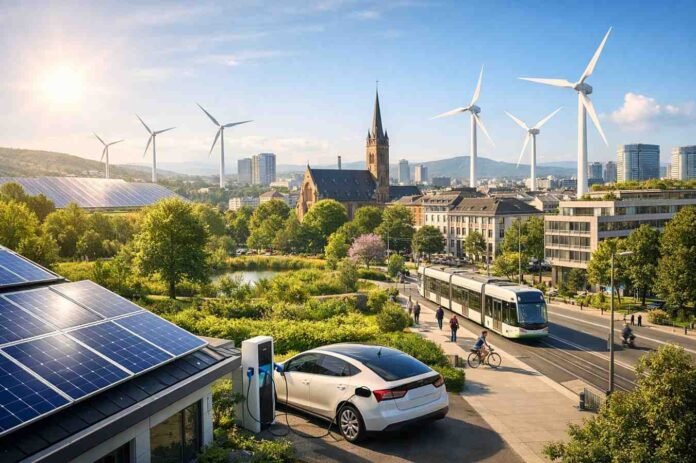
Europe is in the midst of a transformation that reaches far beyond policy documents and political pledges. From the wind-swept coasts of the North Sea to solar-powered villages in southern Spain, a quiet but determined revolution is reshaping how an entire continent produces energy, consumes resources, and imagines its future. This is Europe’s Green Revolution, and its implications for global sustainability are profound.
Unlike past industrial shifts driven primarily by profit or geopolitical competition, this transition is rooted in urgency: climate instability, resource scarcity, and public demand for a healthier planet. What makes Europe’s approach particularly compelling is not just ambition, but execution—combining regulation, innovation, and cultural change in ways few regions have managed to align.
The Foundations of Europe’s Green Revolution
Europe’s sustainability journey did not begin overnight. Decades of environmental advocacy, scientific research, and public pressure laid the groundwork for today’s accelerated progress. However, the turning point came with the recognition that climate action could also be an economic opportunity rather than a burden.
At the heart of this shift is the European Green Deal, a comprehensive framework aiming to make Europe the world’s first climate-neutral continent. Rather than focusing solely on emissions reduction, it integrates energy, agriculture, transportation, manufacturing, and finance into a single sustainability vision.
This holistic approach acknowledges a simple truth: environmental challenges are interconnected, and solving them in isolation rarely works.
Renewable Energy: Powering a New Europe
One of the most visible pillars of Europe’s green transformation is its rapid expansion of renewable energy. Wind, solar, hydro, and geothermal power are no longer fringe alternatives—they are central to Europe’s energy strategy.
Countries like Denmark and Germany have demonstrated that large-scale wind power can reliably support national grids. Southern Europe, blessed with abundant sunlight, is emerging as a solar powerhouse, while innovations in offshore wind are turning coastlines into clean energy hubs.
More importantly, Europe is investing heavily in energy storage, smart grids, and cross-border energy sharing, addressing the intermittency issues that once plagued renewables. The result is a system that is not only cleaner, but increasingly resilient.
Sustainable Cities and the Urban Shift
Europe’s Green Revolution is not confined to power plants and policy rooms—it is reshaping everyday urban life.
Cities across the continent are redesigning themselves around sustainability. Car-free city centers, expanded cycling infrastructure, and electrified public transport are becoming the norm rather than the exception. Paris, Amsterdam, and Copenhagen are proving that reducing car dependency improves not only emissions, but also public health and quality of life.
Urban sustainability efforts also extend to buildings. Energy-efficient retrofitting, green roofs, and low-carbon construction materials are helping cities dramatically reduce their environmental footprint while creating new jobs in the green construction sector.
Circular Economy: Redefining Growth
Perhaps one of Europe’s most influential contributions to global sustainability is its commitment to the circular economy. Instead of the traditional “take, make, dispose” model, Europe is pushing industries toward systems where waste is minimized and materials are continuously reused.
This shift affects everything from electronics and fashion to food systems and packaging. Products are increasingly designed for durability, repairability, and recyclability. Consumers are encouraged—not forced, but incentivized—to participate through better labeling, deposit systems, and repair rights.
By decoupling economic growth from raw resource consumption, Europe is challenging a long-standing assumption of modern economics: that prosperity must come at the expense of the planet.
Agriculture and Food Systems: Sustainability from the Ground Up
Food production is both a major contributor to climate change and one of its most vulnerable sectors. Europe’s Green Revolution recognizes this dual role.
Through initiatives promoting regenerative farming, reduced pesticide use, and organic agriculture, European food systems are slowly shifting toward practices that restore soil health and biodiversity. Farmers are supported through subsidies that reward environmental stewardship rather than sheer output.
At the consumer level, awareness campaigns and policy nudges are encouraging more plant-based diets, reduced food waste, and locally sourced produce. The result is a food system that prioritizes long-term resilience over short-term yield.
Innovation, Technology, and Green Industry
Sustainability in Europe is not driven by restraint alone—it is fueled by innovation. Clean technology startups, research institutions, and established manufacturers are working together to develop solutions ranging from green hydrogen to carbon-neutral steel.
Hydrogen, in particular, is emerging as a critical component of Europe’s decarbonization strategy, especially for industries that are difficult to electrify. While challenges remain, Europe’s investment in research and infrastructure positions it as a global leader in this emerging field.
Crucially, this green industrial push is also about competitiveness. By setting high environmental standards early, European companies are preparing for a future in which sustainability is not optional, but expected.
The Social Dimension of Sustainability
No green transition can succeed without public support, and Europe’s approach increasingly acknowledges the social side of sustainability.
Policies now emphasize a “just transition”, ensuring that workers and communities dependent on fossil fuel industries are not left behind. Retraining programs, regional investment, and social protections aim to make sustainability inclusive rather than divisive.
This focus on fairness strengthens political legitimacy and reduces resistance—an essential factor in maintaining long-term momentum.
Challenges and Criticisms
Despite its progress, Europe’s Green Revolution is not without obstacles. Energy price volatility, bureaucratic complexity, and uneven progress among member states continue to test the system.
Critics argue that regulations can be overly rigid or that Europe risks outsourcing emissions by importing carbon-intensive goods. These concerns are valid and increasingly addressed through measures like carbon border adjustments and adaptive policy design.
What distinguishes Europe, however, is its willingness to revise, learn, and recalibrate rather than abandon its sustainability goals altogether.
What Europe’s Green Revolution Means for the World
Europe’s sustainability journey is not a template that can be copied wholesale by other regions, but it offers powerful lessons.
It demonstrates that climate action can coexist with economic growth, that regulation can drive innovation rather than stifle it, and that citizens will support ambitious change when they see tangible benefits in their daily lives.
As climate challenges intensify globally, Europe’s experience provides both inspiration and practical insight into what a sustainable future might look like.
The Future of Sustainability in Europe
Looking ahead, Europe’s Green Revolution is far from complete. Achieving full climate neutrality will require continued investment, political resolve, and cultural adaptation. Yet the trajectory is clear.
Sustainability in Europe is no longer a niche concern or a political talking point—it is becoming a defining feature of how societies function. Energy systems, cities, industries, and lifestyles are evolving together, shaping a future that balances human prosperity with ecological limits.
In that sense, Europe’s Green Revolution and the future of sustainability are inseparable. What unfolds across the continent in the coming years will not only determine Europe’s environmental legacy, but also influence how the world responds to the greatest challenge of our time.