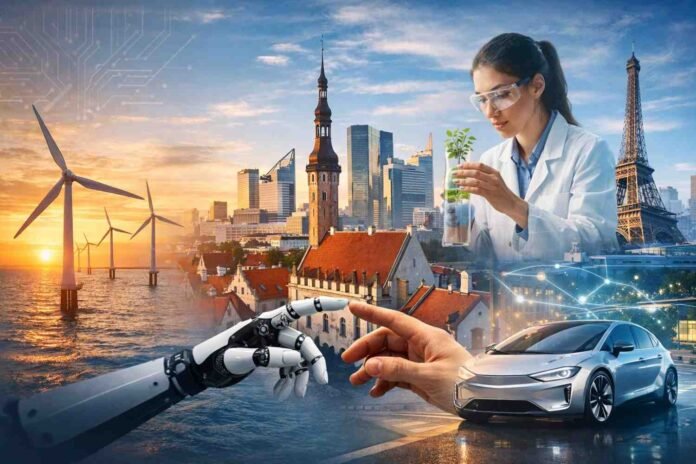
For centuries, Europe has been defined by its traditions—ancient cities, classical education, legacy institutions, and deeply rooted cultural identities. But today, a quieter revolution is reshaping the continent. From green technology hubs in Scandinavia to AI-powered startups in Central Europe, a New Europe is emerging—one that respects its past while boldly innovating beyond it.
This transformation is not about abandoning tradition. It’s about reimagining it for a rapidly changing world.
A Continent Reinventing Itself
Europe’s strength has always been its ability to adapt. After wars, economic crises, and political shifts, the continent has repeatedly reinvented itself. The current wave of innovation reflects a similar moment—driven by digital transformation, sustainability, and a new generation of entrepreneurs who think globally but act locally.
Unlike the “move fast and break things” culture often associated with Silicon Valley, European innovation tends to be deliberate, ethical, and socially grounded. This approach is becoming a competitive advantage.
Innovation Rooted in Values
One of the defining features of the new European innovation landscape is its value-driven foundation.
Human-Centered Technology
European tech companies are increasingly focused on:
- Data privacy and digital rights
- Ethical artificial intelligence
- Transparent governance
Regulations like GDPR are often seen as constraints, but they have pushed European innovators to build trust-first technologies—a critical asset in a world growing wary of unchecked digital power.
Sustainability as Strategy
Europe is not just talking about climate change; it is engineering solutions:
- Renewable energy leadership in wind and solar
- Circular economy models in manufacturing
- Sustainable urban planning in cities like Copenhagen, Amsterdam, and Vienna
Green innovation is no longer a niche—it’s a core economic strategy.
Startups Beyond the Usual Capitals
While London, Paris, and Berlin remain influential, Europe’s innovation story now extends far beyond traditional power centers.
- Tallinn has become a digital governance pioneer
- Lisbon is a rising hub for global startups and remote workers
- Warsaw and Prague are attracting deep-tech investment
- Barcelona blends creative industries with smart-city innovation
This decentralization makes Europe uniquely resilient, spreading opportunity across borders rather than concentrating it in a single region.
Education Meets Experimentation
Europe’s world-class universities are no longer isolated ivory towers. They are increasingly integrated into startup ecosystems, research accelerators, and public-private partnerships.
New models are emerging where:
- Academic research moves faster into real-world applications
- Students become founders, not just graduates
- Lifelong learning replaces linear career paths
This blend of rigorous education and entrepreneurial experimentation is helping Europe compete in fields like biotech, quantum computing, and advanced materials.
Tradition as a Launchpad, Not a Limitation
What makes the New Europe distinctive is how it treats tradition—not as a constraint, but as a foundation.
Historic craftsmanship inspires modern design.
Centuries-old agricultural knowledge informs sustainable food tech.
Philosophical traditions shape ethical frameworks for AI and automation.
Rather than erasing the past, Europe is upgrading it.
The Global Impact of the New Europe
As geopolitical uncertainty rises and technological power reshapes societies, Europe’s model offers an alternative path—one that balances innovation with responsibility.
The New Europe demonstrates that:
- Progress does not require cultural erasure
- Technology can advance without sacrificing human dignity
- Economic growth can align with environmental stewardship
This approach is increasingly influential far beyond the continent.
Looking Ahead
The New Europe is still being written. Challenges remain—bureaucracy, uneven investment, and political fragmentation—but the direction is clear.
Europe is no longer just the guardian of history.
It is becoming a laboratory for the future.
By innovating beyond tradition—without abandoning it—Europe is redefining what modern progress looks like in the 21st century.