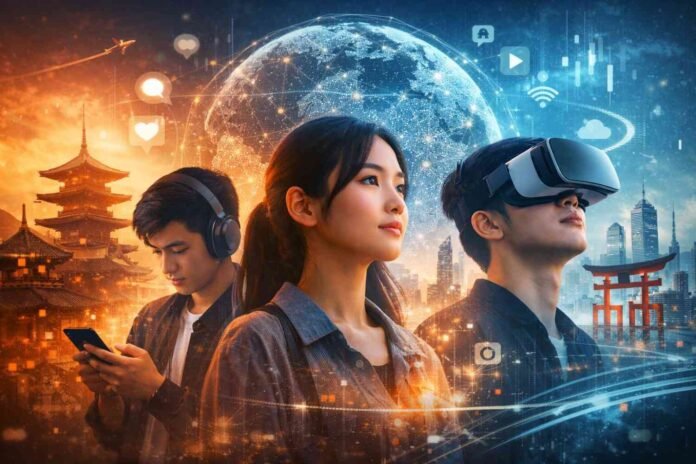
Across Asia, a quiet but powerful transformation is unfolding. From Seoul to Singapore, Bangalore to Bandung, young people are redefining what it means to be Asian in an era shaped by smartphones, social media, artificial intelligence, and global connectivity. Technology is no longer just a tool; it is a cultural force that is reshaping identity, ambition, language, creativity, and community.
The relationship between youth, technology, and the new Asian identity is complex, layered, and deeply human. It is a story of tension and possibility—where tradition meets innovation, and local roots stretch into global networks.
A Generation Born Into Digital Hybridity
Today’s Asian youth are the first generation to grow up fully immersed in digital ecosystems. For many, the internet arrived not as a luxury but as a default environment. This has produced a generation that is inherently hybrid—equally fluent in local cultural codes and global digital language.
A teenager in Jakarta may celebrate traditional holidays with family while running a global dropshipping business on TikTok. A university student in India might learn classical philosophy by day and build open-source software with collaborators across three continents by night. These are not contradictions; they are defining features of the new Asian identity.
Technology has collapsed distance, allowing young Asians to engage with the world without abandoning their cultural context. Identity is no longer shaped only by geography, but by algorithms, online communities, and shared digital experiences.
Rewriting Cultural Narratives Through Social Media
For decades, Asian identities were often defined externally—through stereotypes in Western media or rigid expectations within local societies. Social media has disrupted this dynamic.
Platforms like YouTube, Instagram, WeChat, and TikTok have given Asian youth the power to tell their own stories. Creators are redefining beauty standards, challenging outdated gender norms, reviving endangered languages, and remixing traditional art forms with modern aesthetics.
This is not cultural erasure; it is cultural evolution. Young people are using technology to preserve heritage while adapting it for contemporary life. A traditional dance becomes a viral short video. Ancient poetry finds new life as spoken word content. What once felt old-fashioned becomes relevant again through digital reinterpretation.
Technology as a Tool of Empowerment—and Pressure
While technology empowers, it also intensifies pressure. Asian youth often navigate high expectations around academic success, career stability, and family responsibility. Digital platforms amplify comparison, competition, and visibility.
Success is no longer measured only by grades or job titles, but by followers, engagement metrics, and online validation. This can create anxiety, burnout, and a constant sense of being “behind.”
Yet, many young Asians are responding with resilience and creativity. Mental health conversations—once taboo in many Asian cultures—are now emerging online. Youth-led communities are openly discussing stress, identity conflict, and self-worth, using technology not just to perform success, but to question its meaning.
Global Citizenship Without Cultural Loss
One of the most defining aspects of the new Asian identity is global fluency. Young people across Asia consume international content, collaborate across borders, and participate in global movements—whether related to climate action, digital rights, or social justice.
However, this global engagement does not necessarily dilute cultural identity. Instead, it often strengthens it.
By seeing themselves reflected—and sometimes misrepresented—on the global stage, Asian youth become more intentional about who they are and what they stand for. Technology enables them to assert an identity that is neither traditionally conservative nor fully Westernized, but distinctly their own.
Innovation Rooted in Local Reality
Local needs rather than imported models increasingly shape Asia’s youth-driven tech innovation. From fintech solutions designed for unbanked populations to education platforms tailored for multilingual societies, young innovators are building technology that reflects lived Asian realities.
This approach challenges the idea that technological progress must follow a Western blueprint. The new Asian identity in tech is pragmatic, community-oriented, and often socially conscious. It values scale, yes—but also relevance and impact.
The Future of Asian Identity in a Digital World
The intersection of youth, technology, and the new Asian identity is not a finished story. It is an ongoing process—dynamic, sometimes messy, but deeply hopeful.
As artificial intelligence, virtual reality, and decentralized platforms continue to evolve, Asian youth will not merely adapt; they will shape these technologies in their own image. The future Asian identity will likely be plural, flexible, and self-defined—rooted in history, fluent in technology, and confident in its global voice.
In this transformation, one truth stands out: technology is not replacing culture. In the hands of Asia’s youth, it is becoming a powerful medium through which culture is questioned, preserved, and reimagined.