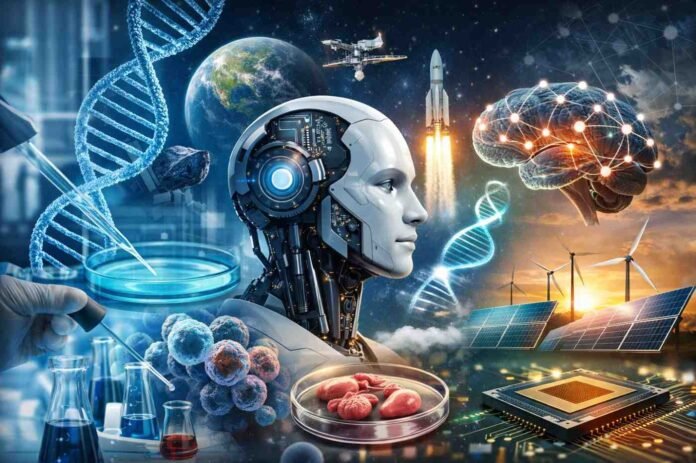
Science has always been the quiet architect of human progress. Yet in the last two decades, discoveries once confined to academic journals have begun reshaping everyday life at a speed few generations have experienced before. From medicine and energy to artificial intelligence and space exploration, modern scientific breakthroughs are not merely advancing knowledge—they are redefining how humans live, heal, communicate, and survive.
This article explores the most impactful scientific discoveries that are transforming human life, focusing on real-world applications, long-term implications, and why these innovations matter now more than ever.
1. CRISPR Gene Editing: Rewriting the Code of Life
One of the most revolutionary scientific discoveries of the 21st century is CRISPR-Cas9 gene editing. Unlike older genetic modification techniques, CRISPR allows scientists to edit DNA with remarkable precision, speed, and affordability.
Why It Matters
CRISPR is already transforming:
- Management of hereditary conditions, including cystic fibrosis and sickle cell anemia
- Cancer research through personalized therapies
- Agricultural resilience by creating drought- and disease-resistant crops
What makes CRISPR especially transformative is its potential to prevent inherited diseases before birth, shifting medicine from treatment to prevention.
2. Artificial Intelligence and Machine Learning in Science
Artificial intelligence is no longer limited to automation or chatbots. Its integration into scientific research is accelerating discovery across disciplines.
Real-World Impact
AI systems are now:
- Detecting cancer earlier than human radiologists
- Predicting protein structures, solving problems that stumped scientists for decades
- Optimizing drug discovery, reducing development time from years to months
Rather than replacing humans, AI is amplifying human intelligence—allowing researchers to see patterns and solutions that were previously invisible.
3. mRNA Technology: A New Era in Medicine
The rapid development of mRNA vaccines marked a turning point in biomedical science. While the technology gained public attention during the COVID-19 pandemic, its implications extend far beyond infectious diseases.
Transformational Potential
mRNA-based treatments are being explored for:
- Cancer immunotherapy
- HIV and malaria vaccines
- Rare genetic conditions
Unlike traditional vaccines, mRNA platforms are adaptable and fast to produce, making global responses to future health crises far more effective.
4. Renewable Energy Breakthroughs Powering a Sustainable Future
Scientific discoveries in renewable energy are redefining humanity’s relationship with the planet. Innovations in solar, wind, and energy storage are making clean power more efficient and affordable than fossil fuels in many regions.
Key Advancements
- Therapy for hereditary conditions, such as sickle cell anemia and cystic fibrosis
- Solid-state batteries offering longer life and faster charging
- Green hydrogen as a zero-emission fuel alternative
These breakthroughs are not just environmental wins—they are reshaping global economics, geopolitics, and energy independence.
5. Neuroscience and Brain–Computer Interfaces
One of science’s biggest problems has always been comprehending the human brain. Recent discoveries in neuroscience are now translating into life-changing technologies.
Life-Changing Applications
- Brain–computer interfaces enabling paralyzed individuals to communicate
- Neural implants restoring movement and sensory perception
- Advances in mental health treatment through precision neurostimulation
As neuroscience progresses, the boundary between biology and technology continues to blur—raising both extraordinary opportunities and ethical questions.
6. Quantum Computing: Redefining What Computers Can Solve
The processing of information has fundamentally changed as a result of quantum computing. Instead of binary bits, quantum computers use qubits that can exist in multiple states simultaneously.
Why Quantum Science Matters
Quantum breakthroughs could:
- Revolutionize drug discovery and material science.
- Break existing encryption systems while enabling new secure communication.
- Optimize complex systems such as global logistics and climate modeling.
Though still in early stages, quantum science is poised to solve problems classical computers never could.
7. Space Science and the Search for Life Beyond Earth
Scientific discoveries in space are reshaping humanity’s understanding of its place in the universe. Advanced telescopes and space probes are revealing planets, atmospheres, and cosmic phenomena with unprecedented clarity.
Transformative Discoveries
- Identification of Earth-like exoplanets
- Evidence of water on Mars and icy moons
- Insights into dark matter and cosmic expansion
Beyond curiosity, space science drives innovations in materials, communication, and climate monitoring that directly benefit life on Earth.
8. Biotechnology and Lab-Grown Organs
Organ shortages remain a global medical crisis. Scientific breakthroughs in biotechnology are offering a solution through lab-grown tissues and organs.
Medical Transformation
- 3D-printed organs tailored to individual patients
- Reduced risk of organ rejection
- Ethical alternatives to animal testing
This field has the potential to extend life expectancy and dramatically improve the quality of life for millions.
How These Discoveries Are Changing Everyday Life
What sets today’s scientific discoveries apart is their speed of adoption. Innovations move rapidly from laboratory experiments to real-world applications. Smartphones powered by AI, personalized medicine, renewable-powered homes, and digital healthcare are no longer futuristic concepts—they are daily realities.
Science is no longer something happening “out there.” It is embedded in how we live, work, heal, and connect.
The Ethical Responsibility of Scientific Progress
With great discovery comes great responsibility. Gene editing, AI decision-making, and neurotechnology raise serious ethical questions about privacy, equity, and control.
The challenge facing humanity is not whether science will transform human life—it already has—but whether society can guide these transformations wisely and inclusively.
Final Thoughts
The scientific discoveries transforming human life today are not isolated breakthroughs. They are interconnected advances shaping a future defined by longer lives, cleaner energy, smarter technology, and a deeper understanding of ourselves and the universe.
As science continues to evolve, one truth remains clear: human progress is no longer limited by imagination, but by how responsibly we choose to apply what we discover.