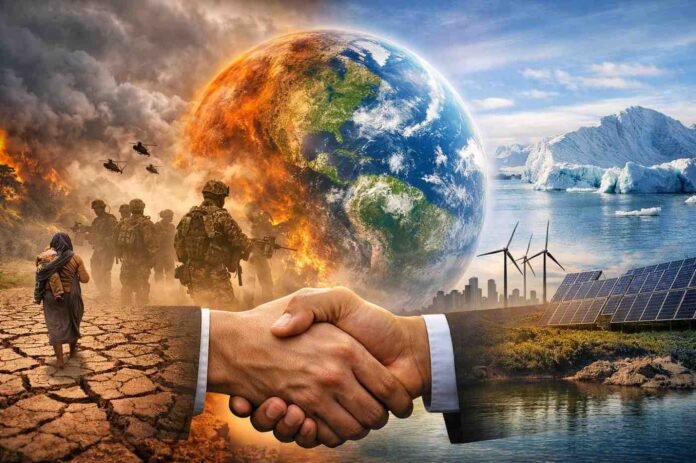
Climate change is now a defining factor influencing international relations, economic security, and global stability rather than a remote environmental issue. Across continents, rising temperatures, extreme weather events, and environmental degradation are intensifying political tensions while simultaneously creating new opportunities for cooperation. Understanding the complex relationship between climate change, conflicts, and cooperation worldwide is essential for policymakers, businesses, and citizens navigating an increasingly interconnected world.
Climate Change as a Conflict Multiplier
Climate change rarely causes conflict on its own, but it acts as a powerful threat multiplier. By straining already fragile social, economic, and political systems, environmental stress can escalate existing tensions into open conflict.
Resource Scarcity and Competition
As water sources dry up, arable land shrinks, and food systems become less reliable, competition for essential resources intensifies. Regions dependent on agriculture—particularly in parts of Sub-Saharan Africa, the Middle East, and South Asia—are seeing climate-driven scarcity exacerbate disputes between communities, ethnic groups, and even neighboring states.
For example, prolonged droughts can push rural populations into cities, overwhelming infrastructure and increasing unemployment. These pressures often fuel political unrest and deepen social divisions, especially where governance is weak.
Climate-Induced Migration and Instability
Millions of people are being displaced globally due to harsh weather events, desertification, and rising sea levels. Climate migration places pressure on receiving regions, sometimes triggering xenophobia, border tensions, and political polarization.
When migration intersects with poverty, fragile institutions, and historical grievances, the risk of violence increases—making climate change a silent but persistent driver of instability.
The Geopolitics of a Warming World
Climate change is reshaping global power dynamics. Melting Arctic ice is opening new shipping routes and access to untapped natural resources, intensifying strategic competition among major powers. At the same time, countries most vulnerable to climate impacts often lack the political influence or financial capacity to adapt effectively.
This imbalance raises critical questions about climate justice, responsibility, and the role of wealthier nations in supporting global resilience.
Cooperation in the Face of Shared Risk
Despite its destabilizing potential, climate change also creates powerful incentives for cooperation. Because environmental threats cross borders, no nation can address them alone.
International Climate Agreements
Global frameworks such as multilateral climate accords have demonstrated that collective action is possible, even among geopolitical rivals. These agreements encourage emissions reductions, technology sharing, and financial support for adaptation and mitigation efforts.
While implementation challenges remain, such cooperation has helped normalize climate diplomacy as a core component of international relations.
Regional and Cross-Border Collaboration
Shared ecosystems—rivers, forests, oceans—are increasingly managed through cross-border agreements. Cooperative water-management initiatives, early-warning systems for extreme weather, and joint renewable energy projects show how climate challenges can foster trust rather than conflict.
In regions with a history of political tension, environmental cooperation has even served as a confidence-building measure, opening channels for broader dialogue.
Climate Change, Security, and the Future of Peace
Security institutions worldwide now recognize climate change as a strategic risk. Militaries are adapting infrastructure, governments are integrating climate risk into national security planning, and international organizations are prioritizing climate resilience as a peacebuilding tool.
Investing in sustainable development, climate-smart agriculture, and disaster preparedness can reduce the likelihood that environmental stress turns into violent conflict. In this sense, climate action is not just environmental policy—it is preventive diplomacy.
Why Global Cooperation Is No Longer Optional
The relationship between climate change, conflicts, and cooperation worldwide highlights a fundamental truth: global stability in the 21st century depends on how effectively nations work together to address environmental challenges.
Unchecked climate change will continue to strain societies and amplify conflict risks. Coordinated climate action, on the other hand, offers a pathway toward shared security, economic resilience, and long-term peace.
Conclusion: A Choice Between Division and Collective Action
Global engagement is changing as a result of climate change. It can deepen divisions and fuel conflict—or it can become a catalyst for unprecedented cooperation. The outcome depends on political will, international solidarity, and the recognition that environmental security and human security are inseparable.
As the world warms, the choice becomes clearer: compete over diminishing resources, or cooperate to protect a shared future.