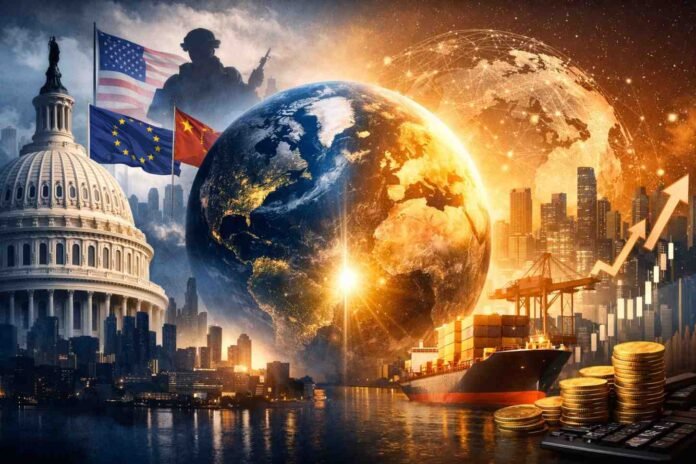
In today’s globalized world, it is nearly impossible to separate politics from economics. Decisions made in presidential offices, parliaments, and international summits ripple through markets, supply chains, and household budgets across continents. To truly understand how the modern world works, one must understand how world politics and economy are interconnected—and why this relationship shapes everything from inflation and employment to wars and alliances.
This connection is not an abstract theory. It is a lived reality.
The Fundamental Link Between Politics and Economics
At its core, politics determines who has power, while economics determines how resources are distributed. When combined, they define how societies function both domestically and internationally.
Governments influence economies through:
- Trade agreements and tariffs
- Taxation and fiscal policy
- Monetary regulation and interest rates
- Sanctions, subsidies, and industrial policy
At the same time, economic strength shapes political power. Wealthier nations typically exert greater influence over global institutions, diplomacy, and even military outcomes.
This two-way relationship forms the backbone of global affairs.
How World Politics Shapes the Global Economy
1. Trade Policies and International Relations
Political relationships between countries directly affect trade flows. Friendly nations tend to sign free trade agreements, while hostile relations often result in tariffs, embargoes, or outright bans.
For example:
- Trade wars can raise prices for consumers worldwide.
- Diplomatic alliances can create powerful economic blocs.
- Political disputes can disrupt supply chains overnight.
When governments change their stance, markets react immediately—often before policies are even implemented.
2. Sanctions as Economic Weapons
Sanctions have become one of the most powerful tools in modern geopolitics. Rather than using military force, countries increasingly use economic pressure to achieve political goals.
Sanctions can:
- Cripple national currencies
- Isolate countries from global banking systems.
- Reduce access to technology, food, or energy.
However, sanctions rarely affect only one nation. Global oil prices, commodity markets, and multinational corporations often feel the impact as well.
3. Political Stability and Investor Confidence
Political stability is one of the most important factors investors consider. Countries with predictable governance, the rule of law, and transparent institutions attract more foreign investment.
On the other hand:
- Political unrest drives capital flight.
- Corruption increases borrowing costs.
- Sudden regime changes destabilize markets.
In this way, politics directly determines economic growth—or stagnation.
How the Global Economy Influences World Politics
1. Economic Power Equals Political Influence
Economic strength gives countries leverage on the world stage. Nations with large economies can:
- Influence global financial institutions.
- Set international trade standards.
- Provide or withhold economic aid.
This is why emerging economies often seek not just growth, but strategic industries and currency influence.
2. Economic Crises Trigger Political Change
History shows that economic downturns frequently lead to political upheaval. High unemployment, inflation, and inequality fuel public dissatisfaction, which can reshape governments and ideologies.
Economic stress can lead to:
- Populist movements
- Protectionist policies
- Radical shifts in foreign policy
Domestic economic pain often spills into international relations, changing alliances and priorities.
3. Energy, Resources, and Geopolitical Strategy
Control over critical resources—such as oil, gas, rare earth minerals, and food—gives countries enormous political leverage.
Energy-exporting nations often wield influence far beyond their size, while resource-dependent countries must carefully manage diplomatic relationships to ensure supply security.
As the world transitions toward renewable energy, new geopolitical dynamics are emerging around technology, minerals, and climate policy.
Global Institutions: Where Politics and Economics Collide
International organizations sit at the intersection of world politics and the global economy.
Institutions such as:
- International financial bodies
- Trade organizations
- Development banks
They are shaped by political power structures while enforcing economic rules. Voting rights, lending conditions, and policy recommendations often reflect geopolitical realities as much as economic logic.
This is where global cooperation and competition coexist—sometimes uneasily.
The Role of Developing and Emerging Economies
Developing nations experience the politics-economy connection most intensely. Political decisions in powerful countries can:
- Affect debt burdens
- Influence currency stability
- Shape development pathways
At the same time, emerging economies are increasingly asserting political independence by diversifying trade partners, investing in regional alliances, and building domestic industries.
Their rise is reshaping the global balance of power.
Technology, Economics, and Political Competition
Technology has added a new layer to the relationship between world politics and the economy. Governments now compete not only over land and resources, but also over:
- Semiconductors
- Artificial intelligence
- Digital infrastructure
- Data control
Economic dominance in technology translates directly into political influence, national security advantages, and long-term global leadership.
Why Understanding This Interconnection Matters
Understanding how world politics and the economy are interconnected is no longer optional. It affects:
- Business decisions
- Career opportunities
- Investment strategies
- National security
- Every day cost of living
From interest rate changes to fuel prices, from trade disruptions to currency fluctuations, political choices shape economic realities—often faster than people expect.
Final Thoughts
World politics and the global economy are not separate systems operating in isolation. They are deeply intertwined forces, constantly shaping and reshaping one another. Political power influences economic outcomes, while economic realities redefine political strategies.
In an era of rapid change, rising multipolarity, and global uncertainty, understanding this relationship is essential for anyone seeking to navigate the modern world—whether as a citizen, professional, or policymaker.
The future will belong to those who grasp not just what is happening globally, but why politics and economics move together.